

14
2023
-
03
What types of swab packaging machines are there?
Author:
Over the past year or two, China has frequently been affected by outbreaks, leading to widespread nucleic acid testing campaigns. This, in turn, has created a massive demand for swabs—and consequently, many manufacturers are seeking high-capacity swab packaging machines. But do you know what types of swab packaging machines are available? 1. **Blister Packaging (also known as Stretch Film Packaging):** This method uses a mold to heat and press a sheet of material into an凹-shaped cavity, which is then cooled with water to set its form. Swabs like nasal or throat swabs are placed directly into these cavities, after which the film and blister material are sealed together using heat and pressure. One major advantage of this type is that it’s highly efficient in terms of material usage, allowing for extremely compact packaging—often as narrow as 20mm or even 18mm wide. However, a potential drawback is that the packaging may become prone to deformation over time if not handled carefully. 2. **Flat-Press Four-Side Sealing:** In this type of packaging machine, swabs are positioned between layers of paper-based film, and then pressed to create secure four-sided seals. The final product is cut to the desired size using horizontal and vertical cutting tools. This method produces exceptionally flat, aesthetically pleasing packaging that maintains its shape even over extended periods. On the downside, it tends to be more expensive due to higher consumable costs. Typically, the bag width for this method is around 30–35mm. When deciding which swab packaging machine to choose, it ultimately depends on your company’s product positioning. If appearance isn’t a top priority, an **blister packaging machine** might be the better option. But if your brand emphasizes a sleek, professional look, a **flat-press four-side sealing machine** would likely be the ideal choice.
1. Blister packaging, also known as stretch film packaging, is created by heating and applying pressure to a sheet of material using a mold, which shapes it into an凹-shaped design. The molded piece is then cooled with water to set its form. Next, items like nasal swabs or throat swabs are placed into the recessed slots, after which the film and blister material are sealed together using heat and pressure. This type of swab packaging machine helps conserve materials, as the bags can be made extremely small—typically as narrow as 20 millimeters, or even down to 18 millimeters in width. However, a drawback is that the packages may easily become deformed if left for an extended period.
1. Blister packaging, also known as stretch film packaging, is created by heating and applying pressure to a sheet of material using a mold, which forms it into an凹-shaped design. The molded piece is then cooled with water to set its shape. Next, items like nasal swabs or throat swabs are placed into the recessed slots, after which the film and blister material are sealed together using heat and pressure. This type of swab packaging machine helps save materials, as the bags can be made very small—typically as narrow as 20 millimeters, or even down to 18 millimeters in width. However, a drawback is that the packages may easily become deformed if left for an extended period.
2. Flat-pressure four-side sealing type: In this swab packaging machine, the swabs are placed in the center of a paper film, and then pressure is applied to create sealed edges on all four sides. The product is subsequently cut to the desired size using horizontal and vertical cutting machines. This packaging method ensures a perfectly flat finish with an aesthetically pleasing appearance that remains intact even over extended periods. However, the cost of consumables is relatively high. Typically, the bag width is 30 or 35 mm.
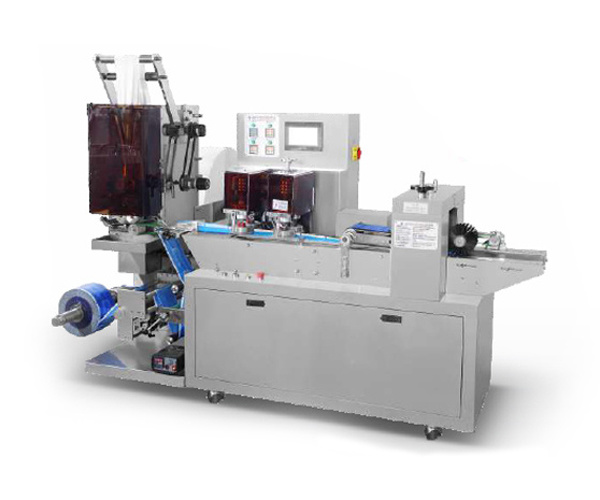
How do you choose a swab packaging machine? This should be determined based on each company’s product positioning. If appearance isn’t a high priority, you can opt for blister-type equipment. However, if aesthetics are crucial, consider flat-pressure four-side sealing machines.
In fact, the working principle of the swab packaging machine is relatively simple. Before operation, the machine uses a forming mold to heat and stretch the material, creating a fixed-shaped groove. The product is then placed into this molded groove. The bottom film is advanced forward by chain-driven clamps, moving into the vacuum heat-sealing area, where vacuum pumping and four-side sealing are completed. Next, the product travels further into the cutting zone, where transverse and longitudinal cuts are made by dedicated horizontal and vertical blades. After cutting, the finished product is conveyed toward the discharge outlet, marking the completion of the entire workflow.
After all, a swab packaging machine is just a machine—yet some people fail to pay attention to safety precautions before operating the equipment. Moreover, proper operation of the device not only ensures smooth functioning but also helps extend its lifespan. So, what should we keep in mind when using a swab packaging machine? It’s important to address this in three stages: before operation, during operation, and after operation.
1. Preparations Before Operating the Swab Packaging Machine
Before starting the equipment, first inspect the workshop environment and hygiene conditions; check for any abnormalities in the equipment and ensure proper grounding. Then, turn on the equipment's power supply and verify that it is functioning correctly.
2. Precautions for Operating the Swab Packaging Machine
The cotton used in the swab packaging machine should be short, degreased cotton strips with a fiber length of 10–35 mm. Additionally, the rods used in the equipment must be round, smooth, fresh, and free of burrs. When operating the device, ensure that the electrical components remain clean and hygienic to prevent overheating and potential fire hazards.
Swab Packaging Machine
Related News

undefined
Follow us
Douyin
Contact us
Address: Plot 7, Yongding Road, Songjiatai Industrial Zone, Feiyun Subdistrict, Ruian City, Zhejiang Province
Phone:86-577-65056881
Mobile phone:86-13616602277 15157790571
Email:razl@vip.qq.com
Navigation